
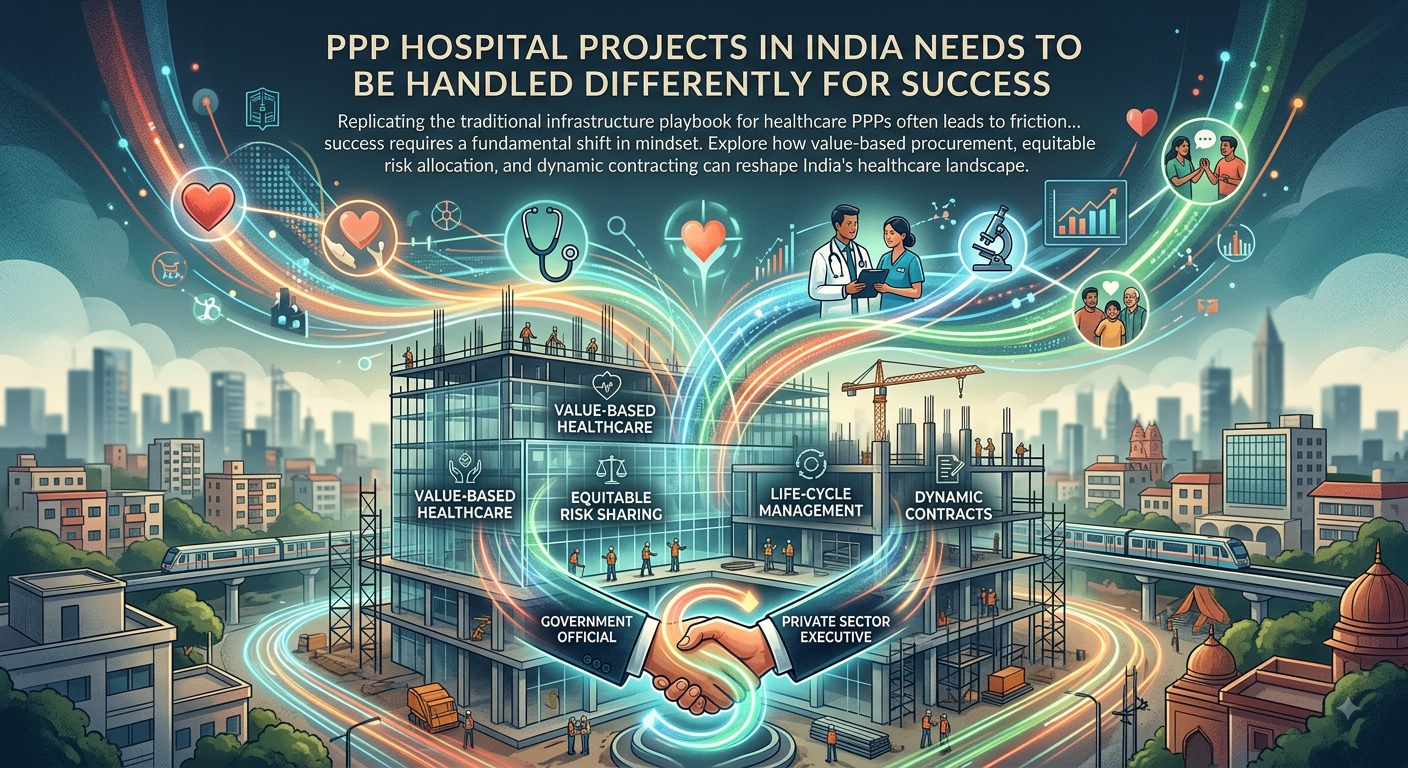
Public-Private Partnerships (PPPs) in India’s infrastructure sectors—like roads and airports—have a established track record. However, replicating the same blueprint for healthcare facility development often leads to friction.
A hospital is not merely physical infrastructure; it is an evolving ecosystem driven by clinical outcomes, specialized medical talent, complex equipment lifecycles, and patient empathy. To drive real success, India's healthcare sector must fundamentally rethink its approach and mindset toward PPP hospital projects.
1. Shift from Cost-Minimization to Value-Based Healthcare Traditionally, healthcare PPP tenders in India heavily weigh the lowest financial bid (L1). In hospital infrastructure, prioritizing cost over outcome leads to compromised clinical quality, delayed technology adoption, and poor patient satisfaction. Stakeholders must pivot toward value-based procurement. Success metrics should evaluate long-term patient outcomes, infection control rates, clinical quality accreditations (like NABH or JCI), and equipment maintenance standards alongside capital efficiency.
2. Equitable Risk Allocation Strategy A primary reason PPP hospital projects stall is asymmetric risk distribution. Private partners are frequently expected to absorb traffic/volume risk, tariff cap pressures, and regulatory uncertainties simultaneously.
Government Role: The public sector should mitigate baseline operational risks by providing clear land titles, streamlined single-window regulatory clearances, and assured minimum patient volume guarantees via government insurance schemes (such as Ayushman Bharat / PM-JAY).
Private Partner Role: The private sector should focus its exposure on operational delivery, clinical excellence, technology integration, and service availability.
3. Move Beyond "Build and Hand Over" to Life-Cycle Management Unlike traditional civil projects, medical technology and diagnostic infrastructure have short obsolescence cycles (typically 5–7 years). Thought processes must shift from static facility construction to long-term asset management. PPP contracts need flexible clauses for periodic technology upgrades, capital reinvestment, and equipment lifecycle management so that facilities do not become obsolete mid-concession.
4. Hybrid Operational Models for Workforce Retention Attracting and retaining qualified specialists, clinicians, and hospital administrators in underserved semi-urban and rural regions remains a critical bottleneck. Successful PPPs require innovative human resource frameworks. Blended staffing models—where public doctors handle core primary/secondary care while private partners deploy visiting specialists, run DNB training programs, or leverage hub-and-spoke telemedicine networks—can bridge skill gaps effectively.
5. Transparent Performance Monitoring & Dynamic Contracts A rigid 20-to-30-year concession contract cannot anticipate shifting disease burdens, technological shifts, or economic fluctuations. Establishing an independent, empowered monitoring authority with real-time digital dashboards ensures transparent tracking of Key Performance Indicators (KPIs). Contracts must incorporate periodic review mechanisms to adjust tariffs, operational guidelines, and service level agreements (SLAs) collaboratively without resorting to dispute resolution.
By transitioning from a transaction-heavy procurement mindset to a collaborative, long-term clinical delivery partnership, India can unlock the full potential of PPP hospital projects to deliver equitable, high-quality, and scalable healthcare.